Types of Business Entities: LLC vs Corporation vs Sole Proprietorship
- Nationwide Legal Assistance
- Feb 24, 2025
- 4 min read
Updated: Apr 17
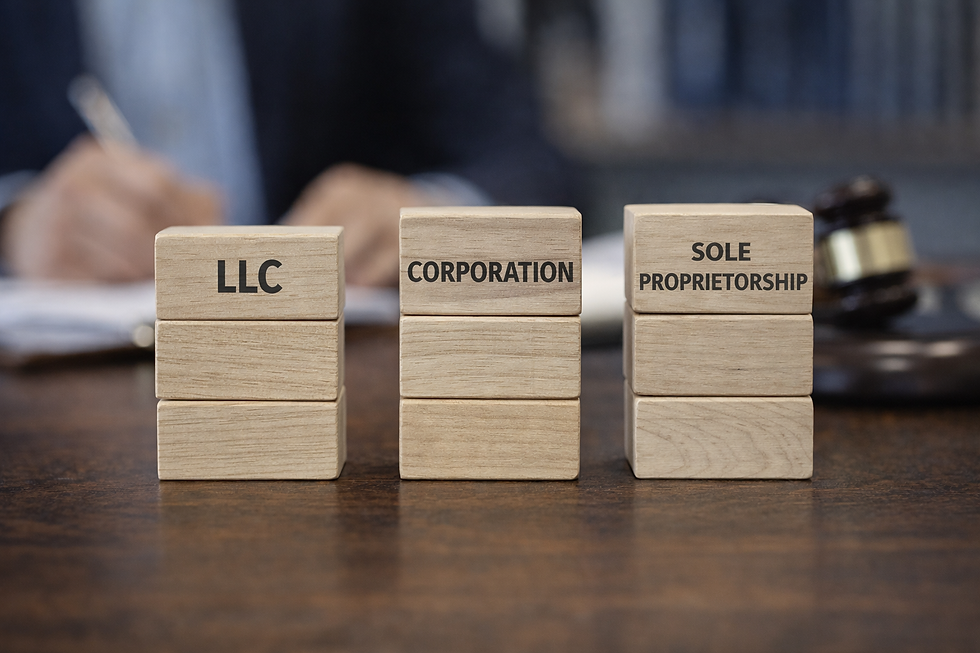
Types of business entities LLC vs corporation vs sole proprietorship is one of the most important decisions entrepreneurs face when starting a business. The structure you choose affects your taxes, liability, and how your business operates.
At Nationwide Legal Assistance, we connect business owners across the United States with experienced attorneys. Understanding the differences between LLCs, corporations, and sole proprietorships helps you choose the right path and protect your future.
Why Your Business Structure Matters
Your business entity is the legal foundation of your company.
It Impacts:
Personal liability
Taxes and reporting
Ability to raise capital
Day-to-day operations
Choosing the wrong structure can lead to unnecessary risks and costs.
What Is a Sole Proprietorship?
A sole proprietorship is the simplest business structure.
Key Features:
Owned and operated by one person
No separate legal entity
Easy and inexpensive to start
Advantages:
Minimal paperwork
Full control of the business
Simple tax filing
Disadvantages:
Unlimited personal liability
Limited ability to raise capital
No separation between personal and business assets
This structure works best for small, low-risk businesses.
What Is an LLC (Limited Liability Company)?
An LLC is a flexible business structure that combines elements of corporations and sole proprietorships.
Key Features:
Separate legal entity
Owners are called members
Flexible tax options
Advantages:
Limited liability protection
Pass-through taxation (profits taxed once)
Less formal requirements than corporations
Disadvantages:
State-specific regulations
Fees and filing requirements
Limited ability to raise large investments
LLCs are popular among small and medium-sized businesses.
What Is a Corporation?
A corporation is a more complex business structure that is legally separate from its owners.
Key Features:
Separate legal entity
Owned by shareholders
Managed by directors and officers
Advantages:
Strong liability protection
Easier to raise capital
Perpetual existence
Disadvantages:
More paperwork and regulations
Higher costs
Potential double taxation (for C corporations)
Corporations are often used by larger businesses or companies seeking investors.
Types of Corporations
C Corporation
Subject to double taxation
Best for large businesses and investors
S Corporation
Avoids double taxation
Limited to 100 shareholders
Must meet IRS requirements
Key Differences Between LLC, Corporation, and Sole Proprietorship
Liability Protection
Sole Proprietorship: No protection
LLC: Limited protection
Corporation: Strong protection
Taxation
Sole Proprietorship: Personal taxes
LLC: Pass-through taxation
Corporation: Double taxation (C Corp) or pass-through (S Corp)
Complexity
Sole Proprietorship: Very simple
LLC: Moderate
Corporation: Complex
Cost
Sole Proprietorship: Low
LLC: Moderate
Corporation: Higher
How to Choose the Right Business Structure
Choosing the right entity depends on your goals and risk level.
Consider:
How much liability protection you need
Your tax preferences
Your plans for growth and investment
Your budget for setup and maintenance
Each structure offers different benefits depending on your situation.
Common Mistakes When Choosing a Business Entity
Avoid these common errors:
Choosing based only on cost
Ignoring liability risks
Not planning for future growth
Failing to understand tax implications
Taking time to choose correctly can save you money and stress.
When Should You Change Your Business Structure?
As your business grows, your needs may change.
You may need to restructure if:
You want to raise capital
Your liability risk increases
Your tax situation changes
Many businesses start as sole proprietorships and later become LLCs or corporations.
Why Legal Guidance Matters
Business formation involves legal and financial decisions that affect your future.
Without proper guidance, you risk:
Personal liability
Tax inefficiencies
Compliance issues
An experienced attorney helps you choose the right structure and set your business up for success.
How Nationwide Legal Assistance Can Help
Nationwide Legal Assistance connects entrepreneurs with experienced business attorneys across the United States.
We stand out because:
You always speak with a live agent
We match you with the right attorney
Our team is fully bilingual (English and Spanish)
We are available 24/7
We help you build your business with confidence.
FAQ: Types of Business Entities LLC vs Corporation vs Sole Proprietorship
1. What is the best business structure for a small business?
An LLC is often a good choice because it offers liability protection and flexible taxes.
2. What is the difference between an LLC and a corporation?
LLCs are simpler and offer flexible taxation, while corporations have more structure and are better for raising capital.
3. Is a sole proprietorship risky?
Yes. It offers no liability protection, meaning your personal assets are at risk.
4. Can I change my business structure later?
Yes. Many businesses start small and transition to LLCs or corporations.
5. Do I need a lawyer to choose a business entity?
While not required, a lawyer helps you avoid costly mistakes and choose the best structure.
6. Which structure is best for raising investors?
Corporations are typically the best option for attracting investors.
Final Thoughts
Understanding types of business entities LLC vs corporation vs sole proprietorship helps you make one of the most important decisions for your business. The right structure protects your assets, improves your tax strategy, and supports your growth.
Nationwide Legal Assistance is here to connect you with trusted attorneys who will guide you every step of the way.


Comments